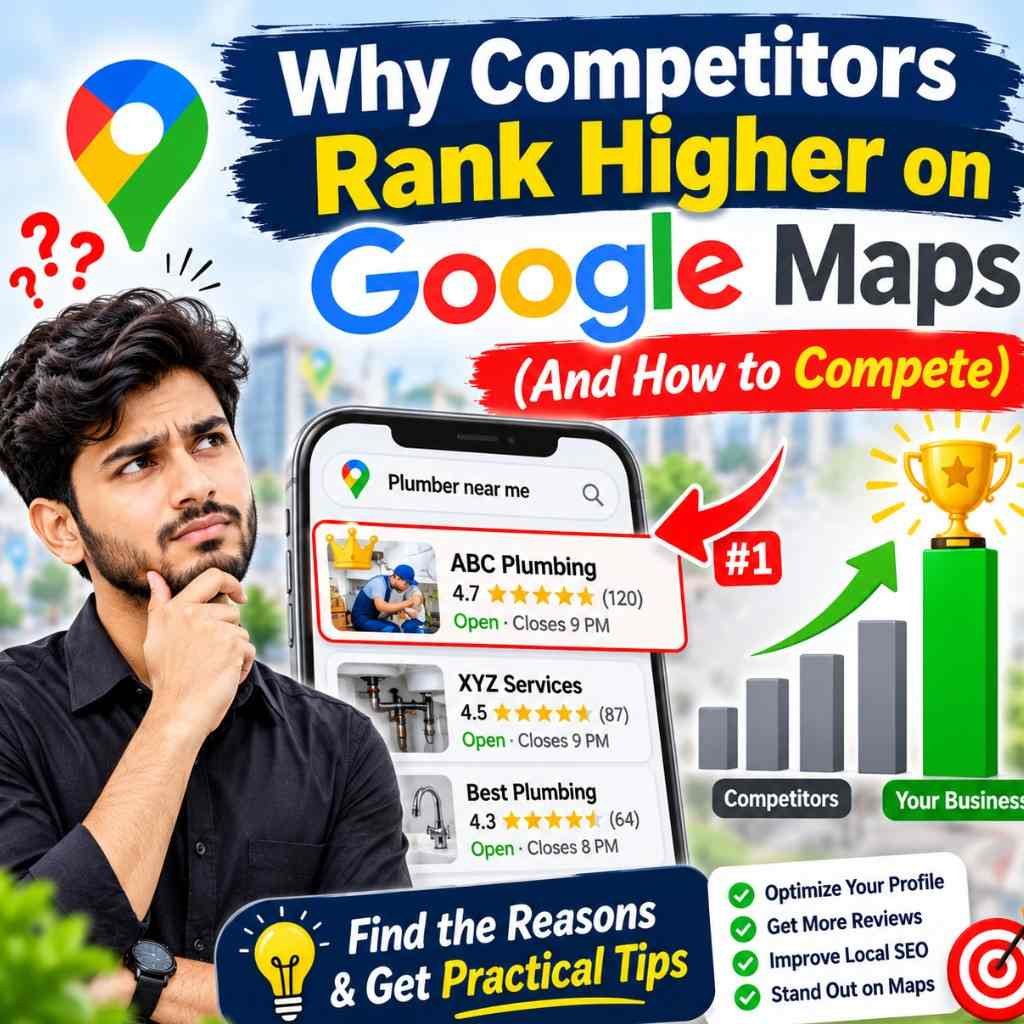
Why Do Competitors Rank Higher on Google Maps?
If my competitors appear above my business on Google Maps, it does not always mean they offer better services or have more customer reviews. Google uses several factors to decide which businesses appear in local search results.
According to Google, local search rankings mainly depend on three factors: relevance, distance, and prominence. These factors help Google decide which businesses best match a customer’s search.
For example, my business may have a 4.9-star rating and more reviews than a nearby competitor. However, that competitor may have better-matched business categories, stronger local signals, or a location closer to the person searching.
I recommend looking beyond star ratings when comparing my business with competitors. I should check these areas first:
- Google Business Profile: Is my business information complete and accurate?
- Customer reviews: Are customers sharing recent and useful feedback?
- Business categories: Do my selected categories match my main services?
- Website SEO: Does my website clearly explain my services and service areas?
- Local citations: Is my business name, address, and phone number consistent across online directories?
Understanding these differences can help me find out why competitors rank higher on Google Maps and where my business needs improvement.
Instead of copying everything my competitors do, I should focus on building a complete, accurate, and trustworthy online presence.
Many business owners want to understand why competitors rank higher on Google Maps and what they can do to catch up.
How Google Decides Which Businesses Rank Higher on Maps
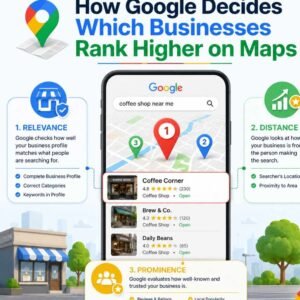
Before I try to outrank my competitors, I need to understand how Google Maps rankings work. Google mainly uses three factors to decide which local businesses appear in search results: relevance, distance, and prominence.
These factors help Google show users businesses that match their search and location. Understanding them can help me find out why another business appears above mine.
Relevance
Relevance means how closely a business matches what someone searches for on Google.
For example, if someone searches for “emergency plumber near me,” Google looks for businesses that offer plumbing services and match that search.
I can improve relevance by:
- Choosing the correct primary and secondary business categories.
- Adding accurate services to my Google Business Profile.
- Writing a clear business description.
- Creating website pages for my main services.
- Keeping my business information updated.
When Google clearly understands what my business offers, it can better match my profile with relevant local searches.
Distance
Distance refers to how far a business is from the person searching or the location included in the search.
For example, if someone searches for “coffee shop near me,” Google may show a nearby coffee shop before one located several miles away.
This is why my competitor may rank higher even if my business has more reviews or a better rating.
I cannot directly control where a customer searches from or move my business closer to them. However, I can make sure my business address and service-area information are accurate.
Prominence
Prominence means how well-known and trusted a business is online and offline.
Google considers information about a business from across the web when determining its prominence. Reviews, website links, and other online information can help Google understand a business’s reputation.
I can work on prominence by:
- Getting genuine reviews from satisfied customers.
- Responding to customer reviews professionally.
- Building relevant local backlinks.
- Keeping business details consistent across directories.
- Publishing useful website content about my services.
A business with stronger prominence signals may rank above a competitor, even if that competitor has a higher star rating.
The important point is that I should not focus on just one ranking factor. Relevance, distance, and prominence work together. Improving the factors I can control gives my business a better chance of appearing in relevant Google Maps searches.
7 Reasons Your Competitors Rank Higher on Google Maps
If my competitors appear above my business on Google Maps, I need to find out what they are doing differently. A higher position does not always mean they have better services. They may have stronger local SEO signals or a more relevant Google Business Profile.
Here are seven common reasons why competitors may rank higher on Google Maps.
Better Google Business Profile Optimization
An incomplete or poorly managed Google Business Profile can make it harder for Google to understand my business.
My competitors may have more accurate business information, better-selected categories, and complete service details. These details help Google understand what their businesses offer.
To improve my profile, I should:
- Add the correct business name, address, and phone number.
- Choose the most relevant primary business category.
- Add accurate business hours.
- List the services I actually provide.
- Upload genuine photos of my business.
- Keep important business information updated.
I should focus on accuracy and useful information instead of adding unnecessary keywords to my profile.
More Relevant Customer Reviews
Customer reviews help people understand the quality of a business before choosing its services. They also contribute to Google’s local ranking signals.
My competitors may have reviews that mention their services, customer experience, and the work they completed. This can help potential customers understand what they offer.
I should encourage satisfied customers to leave honest reviews. I can also respond to positive and negative feedback professionally.
However, I should never buy fake reviews or offer rewards in exchange for positive ratings. Genuine customer feedback is more valuable for building long-term trust.
When competitors rank higher on Google Maps, it usually means their reviews, photos, and citations are stronger and more consistent.
Better Business Categories and Services
Business categories help Google understand what my business does. If I select an incorrect primary category, Google may have difficulty matching my profile with relevant searches.
For example, a plumbing company should choose a category that accurately describes its main business.
I should check whether my competitors use more relevant categories and list services that match their actual work.
I can improve my profile by:
- Selecting the most accurate primary category.
- Adding relevant secondary categories when appropriate.
- Listing the services I genuinely provide.
- Removing outdated or unrelated service information.
I should not select extra categories just because my competitors use them.
Stronger Local SEO and Website Content
My competitors may have better-optimized websites that clearly explain their services and locations.
Google can use information from a business’s website to understand what it offers. A well-organized website can support my Google Business Profile and improve my local search visibility.
For example, if I own an electrical service company, I can create useful pages about electrical repairs, installations, and the areas I serve.
I should focus on:
- Creating separate pages for important services.
- Adding accurate location information.
- Writing helpful content that answers customer questions.
- Making my website mobile-friendly.
- Keeping my contact information consistent.
My goal should be to help customers understand my services, not simply repeat local keywords across every page.
More Consistent Local Citations
Local citations are online mentions of my business name, address, and phone number.
These details may appear on business directories, local websites, and industry listings.
If my competitors have accurate business information across trusted websites, their online presence may be stronger.
I should check my business information on:
- Local business directories.
- Industry-related websites.
- Social media profiles.
- Online business listings.
I should also maintain NAP consistency. NAP stands for Name, Address, and Phone Number.
If my business information is outdated or incorrect, I should update it wherever possible.
Stronger Local Backlinks and Brand Mentions
A backlink is a link from another website to my website. Relevant backlinks can help build my website’s authority and support local SEO.
My competitors may have links from local news websites, business partners, community organizations, or industry-related websites.
I can build relevant backlinks by:
- Working with local business partners.
- Supporting community events.
- Sharing useful industry information.
- Getting mentioned by relevant local websites.
- Creating helpful content that other websites want to reference.
I should focus on earning genuine, relevant links rather than buying large numbers of low-quality backlinks.
Better Location and Business Proximity
Location is another important reason why competitors may rank higher on Google Maps.
Google considers the distance between a business and the person searching. A competitor located closer to the customer may appear above my business, even if I have more reviews or a stronger website.
For example, if someone searches for a dentist near a particular neighborhood, a nearby dental clinic may have an advantage over a clinic located farther away.
I cannot control the searcher’s location or guarantee visibility across every area.
However, I can:
- Keep my business address accurate.
- Set the correct service areas if my business travels to customers.
- Create useful location pages for areas I genuinely serve.
- Make my services and business locations clear on my website.
I should never use a fake address or create false business locations just to improve my rankings.
The key takeaway is that my competitors may rank higher because of several differences in their profiles, reviews, websites, local citations, and locations. I should compare these areas before deciding which improvements my business needs most.
Why Do Competitors Rank Higher With Fewer Reviews?
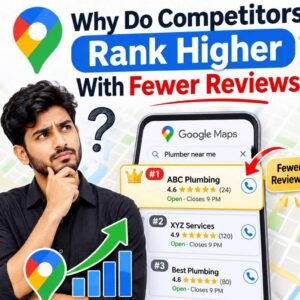
One question I often hear from business owners is: Why does my competitor rank higher on Google Maps when I have more reviews and a better star rating?
The answer is that Google Maps rankings do not depend on review count or star ratings alone. Google considers relevance, distance, and prominence when deciding which businesses appear in local search results.
For example, my business may have 200 reviews with a 4.9-star rating, while a competitor has only 60 reviews with a 4.5-star rating. Still, that competitor may appear higher because its location is closer to the searcher or its business profile better matches the search.
Here are a few things I need to understand:
- Review count is not everything: Having more reviews does not guarantee a higher Google Maps position.
- Location matters: A competitor closer to the person searching may have an advantage.
- Business relevance matters: The competitor’s categories and services may better match the search.
- Overall prominence matters: Other signals, such as website links and local business mentions, can also contribute to prominence.
I should not focus only on getting more reviews. Instead, I need to improve my complete online presence, including my Google Business Profile, website, local citations, and customer experience.
I should also avoid buying reviews or asking customers to leave only positive feedback. Honest reviews help build trust and give potential customers a better understanding of my business.
The bottom line is that a higher star rating and more reviews do not guarantee the top position on Google Maps. I need to look at all three local ranking factors to understand why my competitors are ahead.
How to Check Why Your Competitors Rank Higher on Google Maps
Before I try to improve my Google Maps rankings, I need to understand where my business is falling behind. Guessing what competitors are doing will not help me make the right changes.
I recommend comparing my Google Business Profile, customer reviews, website, and local SEO signals with businesses that rank above me.
Here are three simple ways I can find ranking gaps.
Compare Google Business Profiles
First, I should compare my Google Business Profile with the profiles of my top local competitors.
I can search for my main services on Google Maps and check which businesses appear above mine.
Then, I should compare:
- Primary and secondary business categories.
- Business descriptions and listed services.
- Opening hours and contact information.
- Business photos and other profile details.
- Website links and service information.
This comparison helps me find missing or incorrect information in my own profile.
I should remember that competitors may rank differently depending on the searcher’s location and search terms.
Check Reviews, Categories, and Services
Next, I should compare customer reviews, business categories, and services.
I should not look at review numbers alone. I also need to understand what customers say about each business.
Here is what I should check:
- How many genuine customer reviews do competitors have?
- Are their reviews recent?
- What services do customers mention?
- How does the business respond to customer feedback?
- Are their selected categories relevant to their services?
For example, if a competitor receives regular reviews mentioning emergency plumbing, I should check whether my profile clearly lists emergency plumbing as a service, if I actually offer it.
This helps me understand whether my business information matches what local customers are searching for.
Compare Websites and Local SEO Signals
Finally, I should compare my website with competitor websites.
A competitor may have better service pages, clearer location information, and stronger links from relevant local websites.
I should check:
- Service pages: Do competitors have useful pages for their main services?
- Location pages: Do they clearly explain the areas they serve?
- Website content: Does their content answer common customer questions?
- Local citations: Is their business information accurate across directories?
- Backlinks: Do relevant local websites link to them?
I can use tools such as Google Search Console to understand my website’s search performance and Google Business Profile performance reports to review available profile interactions.
I should also compare Maps results from different locations instead of relying on one search from my own phone.
Once I identify these gaps, I can decide which improvements deserve my attention first.
How to Rank Higher on Google Maps Than Your Competitors
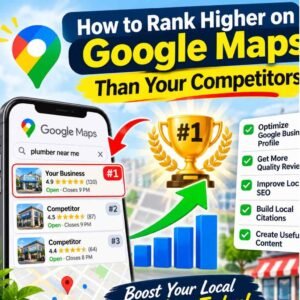
After comparing my business with competitors, I need to fix the areas where my online presence is weak. I cannot control every Google Maps ranking factor, especially distance, but I can improve my business information, customer experience, and local SEO.
Here are five practical steps I can take to improve my Google Maps visibility.
Optimize Your Google Business Profile
I should start by improving my Google Business Profile. Accurate and complete business information helps Google and potential customers understand what my business offers.
I should focus on:
- Choosing the correct primary business category.
- Adding relevant secondary categories.
- Updating business hours and contact details.
- Listing the services I actually provide.
- Adding genuine business photos.
- Keeping my address and service areas accurate.
I should also review my profile regularly and correct outdated information.
Get Genuine Customer Reviews
Customer reviews help build trust and give potential customers more confidence when choosing my business.
I should make it easy for satisfied customers to share honest feedback by providing my Google review link after completing a service.
I can improve my review management by:
- Asking customers for honest reviews.
- Responding to positive and negative feedback.
- Addressing customer complaints professionally.
- Avoiding fake reviews and paid ratings.
- Providing better service to encourage genuine feedback.
I should never pressure customers to leave positive reviews. Honest feedback is important for building a good business reputation.
Improve Your Website’s Local SEO
My website should clearly explain what my business does, which services I offer, and where I serve customers.
I can improve my local SEO by:
- Creating helpful pages for my main services.
- Adding accurate business contact information.
- Including the locations I genuinely serve.
- Making my website mobile-friendly.
- Answering common customer questions.
- Adding relevant internal links between pages.
For example, if I run a plumbing company, I can create separate pages for drain cleaning, pipe repair, and water heater installation.
These pages should provide useful information instead of repeating the same keywords.
Build Consistent Local Citations
I should make sure my business information is accurate across trusted online directories and relevant business websites.
My business name, address, and phone number should match wherever they appear.
To improve NAP consistency, I should:
- Check my existing business listings.
- Find incorrect or outdated information.
- Update my business details.
- Remove duplicate listings where possible.
- Check important directories regularly.
Consistent information makes it easier for customers to find and contact my business.
Earn Relevant Local Backlinks
I should also build relationships with relevant local websites that may mention or link to my business.
For example, I can:
- Partner with other local businesses.
- Support local events and community projects.
- Share useful industry guides.
- Contribute helpful articles to relevant websites.
- Get genuine mentions from local organizations.
I should focus on relevant links rather than collecting random backlinks.
If your competitors rank higher on Google Maps, don’t panic. Fix your profile, get more reviews, and build consistent citations to close the gap.
My main goal is to build a strong and trustworthy local presence. Instead of trying to copy every competitor, I should improve my Google Business Profile, earn genuine reviews, strengthen my website, and keep my business information accurate.
These steps can improve my chances of ranking higher, but no SEO method can guarantee the number-one position on Google Maps.
Frequently Asked Questions
Do More Google Reviews Help Improve Maps Rankings?
More genuine customer reviews can support my business’s online prominence and help build customer trust. However, having more reviews does not guarantee a higher Google Maps position.
Google also considers relevance and distance when ranking local businesses. I should focus on earning honest reviews and providing a good customer experience rather than chasing review numbers.
Why Does a Business With a Lower Rating Rank Higher?
A business with a lower star rating can rank higher because Google Maps rankings depend on more than ratings.
For example, my competitor may have a lower rating but a location closer to the searcher, more relevant business categories, or stronger online prominence.
That is why I should compare all three local ranking factors instead of focusing only on star ratings.
Can a Business Rank Higher Without a Website?
Yes. A business can appear on Google Maps without having its own website.
Google Business Profile provides important business information, such as location, opening hours, phone number, and customer reviews.
However, having a useful website can give customers more information about my services and support my local SEO efforts.
How Long Does It Take to Improve Google Maps Rankings?
There is no fixed timeline for improving Google Maps rankings. Results depend on my current profile, competition, location, and the improvements I make.
Some profile updates may appear relatively quickly, while building customer trust, earning relevant backlinks, and improving website content can take longer.
I should monitor my Google Business Profile performance and local search visibility regularly to understand whether my improvements are working.
Many business owners ask why competitors rank higher on Google Maps. If your competitors rank higher on Google Maps, it usually means their profile, reviews, and citations are stronger than yours.
Now you know exactly why competitors rank higher on Google Maps and how to compete with them step by step.
If you want to fix this properly, check our Google My Business Optimization service. We help businesses outrank their local competitors and get more calls from Google Maps.
You can learn how Google ranks local businesses from Google’s official guide